Saudi Arabia Flag
A government website registered with the Digital Government Authority.
Live Stream LinkLive Stream
Official Saudi Government websites URL ends with.gov.sa .

Website belongs to an official government organization in the Kingdom ofSaudi Arabia always ends with .gov.sa .

Official Reliable websites useHTTPS

Ensure the website is using the HTTPS protocol.

Dga Logo

Registered on Digital Government Authority:

20250724844

News

General Authority for Statistics News

Image Alt Text

"GaStat" : Cost of Living Index remains stable in September 2016

12-09-2017
(6) sections decreased, and (4) rose. "GaStat" : Cost of Living Index remains stable in September 2016 On Monday, the 23th  of Muharram 1438 H/ 24th  of October 2016 AD, the General Authority for Statistics (GaStat) issued the monthly indicator of Saudi cost of living index for the month of September. It is now published on its website www.stats.gov.sa .The indicator didn't record any relative change compared to the previous month.The monthly report indicates that the Saudi cost of living index indicator recorded (137.9) in September 2016 without any relative change compared to August 2016. It recorded an increase above (133.9) from September 2015, recording a rise of 3.0% on an annual basis.The report attributed the monthly increase to the rises of four of the main sections that constitute this indicator; clothes and shoes section with (0,7%), food and beverages with (0.3%), telecommunication section with an increase of (0.2%) , and finally, furniture ,appliances, and maintenance with an increases of (0.1%).On the other hand,  six sections have decreased; commodities and services with a decrease of (1.0%), restaurants and hotels with a decrease of (0,7%), literacy and recreation with (0.4%), transportation with a decrease of (0,2%), housing, water, electricity, gas, and other types of fuels with  a decrease of (0.2%), finally, health section with (0.1%).However, the sections of tobacco and education did not change and remained stable.The cost of living index indicator issued monthly by GaStat aims at providing data about the prices of commodities and services that are in the consumer basket. It also aims at providing data about the cost of living indices within a time series. (The consumer basket) refers to the actual group of commodities and services that are recorded during the household expenditure and income survey. The relative distribution of the commodities and services consumption inside the consumer basket is extracted to make it the base stone in the process of indices calculation. The cost of living indices are used to measure any change in the prices of commodities and services that are purchased by consumer. Moreover, it is used as an accurate indicator that measures the economic inflation and recession. It is also used in statistical and economic analyses that are associated with prices movement and anticipations in different times. Data are collected by conducting interviews. The sources addresses are clarified to the interviewers to facilitate their task. The sources distribution in one city must cover all available commodities and services with all levels.
Image Alt Text

"GaStat" : Cost of Living Index remains stable in September 2016

12-09-2017

(6) sections decreased, and (4) rose. "GaStat" : Cost of Living Index remains stable in September 2016 On Monday, the 23th  of Muharram 1438 H/ 24th  of October 2016 AD, the General Authority for Statistics (GaStat) issued the monthly indicator of Saudi cost of living index for the month of September. It is now published on its website www.stats.gov.sa .The indicator didn't record any relative change compared to the previous month.The monthly report indicates that the Saudi cost of living index indicator recorded (137.9) in September 2016 without any relative change compared to August 2016. It recorded an increase above (133.9) from September 2015, recording a rise of 3.0% on an annual basis.The report attributed the monthly increase to the rises of four of the main sections that constitute this indicator; clothes and shoes section with (0,7%), food and beverages with (0.3%), telecommunication section with an increase of (0.2%) , and finally, furniture ,appliances, and maintenance with an increases of (0.1%).On the other hand,  six sections have decreased; commodities and services with a decrease of (1.0%), restaurants and hotels with a decrease of (0,7%), literacy and recreation with (0.4%), transportation with a decrease of (0,2%), housing, water, electricity, gas, and other types of fuels with  a decrease of (0.2%), finally, health section with (0.1%).However, the sections of tobacco and education did not change and remained stable.The cost of living index indicator issued monthly by GaStat aims at providing data about the prices of commodities and services that are in the consumer basket. It also aims at providing data about the cost of living indices within a time series. (The consumer basket) refers to the actual group of commodities and services that are recorded during the household expenditure and income survey. The relative distribution of the commodities and services consumption inside the consumer basket is extracted to make it the base stone in the process of indices calculation. The cost of living indices are used to measure any change in the prices of commodities and services that are purchased by consumer. Moreover, it is used as an accurate indicator that measures the economic inflation and recession. It is also used in statistical and economic analyses that are associated with prices movement and anticipations in different times. Data are collected by conducting interviews. The sources addresses are clarified to the interviewers to facilitate their task. The sources distribution in one city must cover all available commodities and services with all levels.
Image Alt Text

Dr. Altekhaifi: We aim to unify Data producers' Standards to Serve "GCC" Citizens

12-09-2017
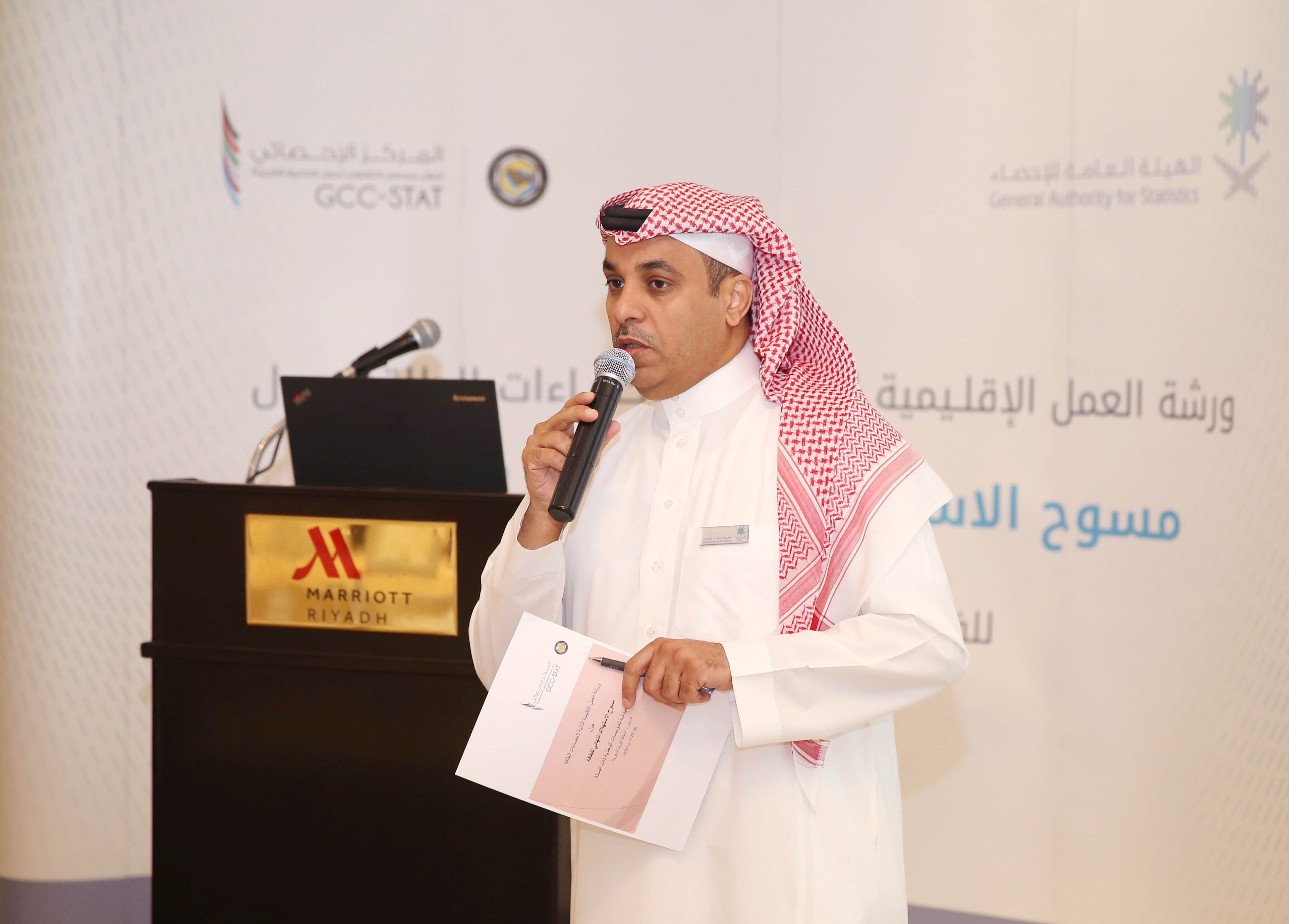
GCC "Energy Statistics" in Riyadh Dr. Altekhaifi: We aim to unify Data producers' Standards to Serve "GCC" Citizens Media center- Riyadh The Chairman of the GCC Statistical center, the Chairman of the General Authority for Statistics in the Kingdom of Saudi Arabia, Dr. Fahad Sulaiman Altekhaifi expressed his thanks and gratitude towards the leaders of the GCC countries for supporting all programs and activities of the "GCC Statistical centre", as a result of their role in supporting all decisions related to the development of GCC nations. Dr. Altekhaifi asserted that the results of the Energy Statistics' Second Regional workshop about the final consumption of energy surveys held in Riyadh city meet the needs of the national and regional policy makers of the energy sector. It will also support everything that would develop the energy sector in GCC countries. Dr. Altekhaifi also added that through this workshop, the GCC statistical centre seeks to strengthen the cooperation between energy statistics producers, and unify the efforts in the used technical standards. In addition, it seeks to implement International standards by all data producers in member countries. Dr. Altekhaifi revealed that the most important role of data producers in this meeting is to reinforce the understanding of the international standards related to energy statistics in the statistics system. In addition, it aims to explain the links between energy data groups and discuss  the user's needs by enhancing the data and its publishing. Moreover, it aims to unify the efforts to raise the awareness about the methodologies needed in preparing energy statistic in the region. Furthermore,  it aims to deepen the participants' understanding of international standards that support energy statistics. Also it clarifies the importance of the final consumption surveys' system. In this workshop the participants reviews the national experiences of the member countries and the importance of the energy final consumption surveys. In addition, the participants visits several energy sector related entities in the kingdom of Saudi Arabia. This workshop continues until  22 March, 2016. It is worth mentioning that The GCC Statistical Centre was established in June 2011 to provide a common official pool of statistics and data for the member states of the GCC. It was also established to support the statistical work of national statistical centers and planning entities in GCC countries.. The Charter was officially endorsed in December 2012 by the GCC Supreme Council (comprised of heads of member states: United Arab Emirates, Kingdom of Bahrain, Kingdom of Saudi Arabia, Sultanate of Oman, State of Qatar and State of Kuwait).
Image Alt Text

Dr. Altekhaifi: We aim to unify Data producers' Standards to Serve "GCC" Citizens

12-09-2017

GCC "Energy Statistics" in Riyadh Dr. Altekhaifi: We aim to unify Data producers' Standards to Serve "GCC" Citizens Media center- Riyadh The Chairman of the GCC Statistical center, the Chairman of the General Authority for Statistics in the Kingdom of Saudi Arabia, Dr. Fahad Sulaiman Altekhaifi expressed his thanks and gratitude towards the leaders of the GCC countries for supporting all programs and activities of the "GCC Statistical centre", as a result of their role in supporting all decisions related to the development of GCC nations. Dr. Altekhaifi asserted that the results of the Energy Statistics' Second Regional workshop about the final consumption of energy surveys held in Riyadh city meet the needs of the national and regional policy makers of the energy sector. It will also support everything that would develop the energy sector in GCC countries. Dr. Altekhaifi also added that through this workshop, the GCC statistical centre seeks to strengthen the cooperation between energy statistics producers, and unify the efforts in the used technical standards. In addition, it seeks to implement International standards by all data producers in member countries. Dr. Altekhaifi revealed that the most important role of data producers in this meeting is to reinforce the understanding of the international standards related to energy statistics in the statistics system. In addition, it aims to explain the links between energy data groups and discuss  the user's needs by enhancing the data and its publishing. Moreover, it aims to unify the efforts to raise the awareness about the methodologies needed in preparing energy statistic in the region. Furthermore,  it aims to deepen the participants' understanding of international standards that support energy statistics. Also it clarifies the importance of the final consumption surveys' system. In this workshop the participants reviews the national experiences of the member countries and the importance of the energy final consumption surveys. In addition, the participants visits several energy sector related entities in the kingdom of Saudi Arabia. This workshop continues until  22 March, 2016. It is worth mentioning that The GCC Statistical Centre was established in June 2011 to provide a common official pool of statistics and data for the member states of the GCC. It was also established to support the statistical work of national statistical centers and planning entities in GCC countries.. The Charter was officially endorsed in December 2012 by the GCC Supreme Council (comprised of heads of member states: United Arab Emirates, Kingdom of Bahrain, Kingdom of Saudi Arabia, Sultanate of Oman, State of Qatar and State of Kuwait).
Image Alt Text

GaStat: Wholesale Price Index Increases in September

12-09-2017

GaStat: Wholesale Price Index Increases in September On Tuesday, the 24th  of Muharram 1438 H/ 25th  of October 2016 AD, the General Authority for Statistics (GaStat) issued the monthly indicator of Saudi wholesale price index for the month of September. It is now published on its website www.stats.gov.sa . The indicator recorded (163.1) with  0.3% increase in September 2016, compared to last month (August) in which it recorded (162.6).The indicator includes ten main sections; Food and living animals section, beverages and tobacco section, raw materials except fuel, mineral fuel and related products section, Fats and oils section, chemical materials and related products, manufactured commodities classified by material section, transportation equipment and machines section, diverse manufactured commodities section, and other commodities section.The report attributed that increase to the rise of three main sections that constitute this indicator; transportation equipment and machines section with (0.9), Food and living animals section with (0.6%), manufactured commodities classified by material section with (0.1%).On the other hand, six sections have decreased: raw materials except fuel section with (1.4%), diverse manufactured commodities section with (0.4%), beverages and tobacco section with (0.3%), Fats and oils section with (0.3%), chemical materials and related products with (0.1%), other commodities with (0.1%), However, the sections of mineral fuel and related products did not change and remained stable.The authority indicated that the Saudi wholesale index measures the average of change in the prices of commodities and services that are sold in the primary markets. What matters here is the price change only. Therefore, the changes that result from the differences in quality, quantity, shipping method, or any other influencing factor in order to get the net price are excluded. This index is provided to everyone, and conducted all over Saudi Arabia.It is worth mentioning that the wholesale price index is used to record any change in the prices of local or imported commodities. In addition to monitoring the price directions and the  status of markets and costs of living. Furthermore, it is used in preparing the national accounts by protecting the income and national aggregates from the influence of price change.
Image Alt Text

GaStat: Wholesale Price Index Increases in September

12-09-2017

GaStat: Wholesale Price Index Increases in September On Tuesday, the 24th  of Muharram 1438 H/ 25th  of October 2016 AD, the General Authority for Statistics (GaStat) issued the monthly indicator of Saudi wholesale price index for the month of September. It is now published on its website www.stats.gov.sa . The indicator recorded (163.1) with  0.3% increase in September 2016, compared to last month (August) in which it recorded (162.6).The indicator includes ten main sections; Food and living animals section, beverages and tobacco section, raw materials except fuel, mineral fuel and related products section, Fats and oils section, chemical materials and related products, manufactured commodities classified by material section, transportation equipment and machines section, diverse manufactured commodities section, and other commodities section.The report attributed that increase to the rise of three main sections that constitute this indicator; transportation equipment and machines section with (0.9), Food and living animals section with (0.6%), manufactured commodities classified by material section with (0.1%).On the other hand, six sections have decreased: raw materials except fuel section with (1.4%), diverse manufactured commodities section with (0.4%), beverages and tobacco section with (0.3%), Fats and oils section with (0.3%), chemical materials and related products with (0.1%), other commodities with (0.1%), However, the sections of mineral fuel and related products did not change and remained stable.The authority indicated that the Saudi wholesale index measures the average of change in the prices of commodities and services that are sold in the primary markets. What matters here is the price change only. Therefore, the changes that result from the differences in quality, quantity, shipping method, or any other influencing factor in order to get the net price are excluded. This index is provided to everyone, and conducted all over Saudi Arabia.It is worth mentioning that the wholesale price index is used to record any change in the prices of local or imported commodities. In addition to monitoring the price directions and the  status of markets and costs of living. Furthermore, it is used in preparing the national accounts by protecting the income and national aggregates from the influence of price change.
Image Alt Text

Director of the Department: transforming statistics into an Authority establishes effective partnerships

12-09-2017

Dr. Fahad Altekhaifi, Director of the Central Department of Statistics and Information, stated that the transformation into a “General Authority” will focus on two principal areas: serving clients and beneficiaries—which encompass all entities that utilize statistical products—and enhancing the quality of these products to more effectively support data-driven decision-making that benefits both citizens and residents.
Altekhaifi explained that the statistical sector, in its new institutional form represented by the Authority and associated statistical departments, will strive to establish effective partnerships across all sectors. The objective is to consolidate the source of official statistics and accelerate their dissemination through formats and services that enable users to leverage the information and maximize its impact.
Speaking during a workshop held yesterday at the Department’s headquarters in Riyadh, which brought together more than thirty officials and specialists from various public and private sector institutions, Altekhaifi emphasized that clients are at the core of the transformation initiative launched by the Department, aimed at establishing a high-caliber statistical authority aligned with international standards relevant to development.
Government and private sector stakeholders involved in statistical work affirmed that the ongoing transformation of Saudi Arabia’s statistical sector—spearheaded by the Central Department of Statistics and Information—is advancing rapidly and cohesively, keeping pace with the evolving demands of both national and global economies.
The workshop, organized by the Central Department of Statistics and Information, aimed to engage all beneficiaries and partners of statistical products in the transition toward the establishment of the General Authority for Statistics (GASTAT), and to develop a unified vision regarding the Authority’s current and future strategic priorities.
The Department’s meeting halls witnessed a dynamic exchange of ideas and expertise, with the participation of representatives from the Ministries of Economy and Planning, Commerce, Labor, Housing, Civil Service, Social Affairs, Education, Health, Culture and Information, Water and Electricity, and Communications and Information Technology. Also in attendance were the General Investment Authority, the Saudi Export Development Authority, the General Commission for Audiovisual Media, the Saudi Arabian Monetary Authority, the e-Government Program (Yesser), King Saud University, Saudi Aramco, and a number of independent Saudi consultants.


Image Alt Text

Director of the Department: transforming statistics into an Authority establishes effective partnerships

12-09-2017

Dr. Fahad Altekhaifi, Director of the Central Department of Statistics and Information, stated that the transformation into a “General Authority” will focus on two principal areas: serving clients and beneficiaries—which encompass all entities that utilize statistical products—and enhancing the quality of these products to more effectively support data-driven decision-making that benefits both citizens and residents.
Altekhaifi explained that the statistical sector, in its new institutional form represented by the Authority and associated statistical departments, will strive to establish effective partnerships across all sectors. The objective is to consolidate the source of official statistics and accelerate their dissemination through formats and services that enable users to leverage the information and maximize its impact.
Speaking during a workshop held yesterday at the Department’s headquarters in Riyadh, which brought together more than thirty officials and specialists from various public and private sector institutions, Altekhaifi emphasized that clients are at the core of the transformation initiative launched by the Department, aimed at establishing a high-caliber statistical authority aligned with international standards relevant to development.
Government and private sector stakeholders involved in statistical work affirmed that the ongoing transformation of Saudi Arabia’s statistical sector—spearheaded by the Central Department of Statistics and Information—is advancing rapidly and cohesively, keeping pace with the evolving demands of both national and global economies.
The workshop, organized by the Central Department of Statistics and Information, aimed to engage all beneficiaries and partners of statistical products in the transition toward the establishment of the General Authority for Statistics (GASTAT), and to develop a unified vision regarding the Authority’s current and future strategic priorities.
The Department’s meeting halls witnessed a dynamic exchange of ideas and expertise, with the participation of representatives from the Ministries of Economy and Planning, Commerce, Labor, Housing, Civil Service, Social Affairs, Education, Health, Culture and Information, Water and Electricity, and Communications and Information Technology. Also in attendance were the General Investment Authority, the Saudi Export Development Authority, the General Commission for Audiovisual Media, the Saudi Arabian Monetary Authority, the e-Government Program (Yesser), King Saud University, Saudi Aramco, and a number of independent Saudi consultants.


Image Alt Text

"GaStat" : Cost of Living Index remains stable in September 2016

12-09-2017

(6) sections decreased, and (4) rose. "GaStat" : Cost of Living Index remains stable in September 2016 On Monday, the 23th  of Muharram 1438 H/ 24th  of October 2016 AD, the General Authority for Statistics (GaStat) issued the monthly indicator of Saudi cost of living index for the month of September. It is now published on its website www.stats.gov.sa .The indicator didn't record any relative change compared to the previous month.The monthly report indicates that the Saudi cost of living index indicator recorded (137.9) in September 2016 without any relative change compared to August 2016. It recorded an increase above (133.9) from September 2015, recording a rise of 3.0% on an annual basis.The report attributed the monthly increase to the rises of four of the main sections that constitute this indicator; clothes and shoes section with (0,7%), food and beverages with (0.3%), telecommunication section with an increase of (0.2%) , and finally, furniture ,appliances, and maintenance with an increases of (0.1%).On the other hand,  six sections have decreased; commodities and services with a decrease of (1.0%), restaurants and hotels with a decrease of (0,7%), literacy and recreation with (0.4%), transportation with a decrease of (0,2%), housing, water, electricity, gas, and other types of fuels with  a decrease of (0.2%), finally, health section with (0.1%).However, the sections of tobacco and education did not change and remained stable.The cost of living index indicator issued monthly by GaStat aims at providing data about the prices of commodities and services that are in the consumer basket. It also aims at providing data about the cost of living indices within a time series. (The consumer basket) refers to the actual group of commodities and services that are recorded during the household expenditure and income survey. The relative distribution of the commodities and services consumption inside the consumer basket is extracted to make it the base stone in the process of indices calculation. The cost of living indices are used to measure any change in the prices of commodities and services that are purchased by consumer. Moreover, it is used as an accurate indicator that measures the economic inflation and recession. It is also used in statistical and economic analyses that are associated with prices movement and anticipations in different times. Data are collected by conducting interviews. The sources addresses are clarified to the interviewers to facilitate their task. The sources distribution in one city must cover all available commodities and services with all levels.
Image Alt Text

Dr. Altekhaifi: We aim to unify Data producers' Standards to Serve "GCC" Citizens

12-09-2017

GCC "Energy Statistics" in Riyadh Dr. Altekhaifi: We aim to unify Data producers' Standards to Serve "GCC" Citizens Media center- Riyadh The Chairman of the GCC Statistical center, the Chairman of the General Authority for Statistics in the Kingdom of Saudi Arabia, Dr. Fahad Sulaiman Altekhaifi expressed his thanks and gratitude towards the leaders of the GCC countries for supporting all programs and activities of the "GCC Statistical centre", as a result of their role in supporting all decisions related to the development of GCC nations. Dr. Altekhaifi asserted that the results of the Energy Statistics' Second Regional workshop about the final consumption of energy surveys held in Riyadh city meet the needs of the national and regional policy makers of the energy sector. It will also support everything that would develop the energy sector in GCC countries. Dr. Altekhaifi also added that through this workshop, the GCC statistical centre seeks to strengthen the cooperation between energy statistics producers, and unify the efforts in the used technical standards. In addition, it seeks to implement International standards by all data producers in member countries. Dr. Altekhaifi revealed that the most important role of data producers in this meeting is to reinforce the understanding of the international standards related to energy statistics in the statistics system. In addition, it aims to explain the links between energy data groups and discuss  the user's needs by enhancing the data and its publishing. Moreover, it aims to unify the efforts to raise the awareness about the methodologies needed in preparing energy statistic in the region. Furthermore,  it aims to deepen the participants' understanding of international standards that support energy statistics. Also it clarifies the importance of the final consumption surveys' system. In this workshop the participants reviews the national experiences of the member countries and the importance of the energy final consumption surveys. In addition, the participants visits several energy sector related entities in the kingdom of Saudi Arabia. This workshop continues until  22 March, 2016. It is worth mentioning that The GCC Statistical Centre was established in June 2011 to provide a common official pool of statistics and data for the member states of the GCC. It was also established to support the statistical work of national statistical centers and planning entities in GCC countries.. The Charter was officially endorsed in December 2012 by the GCC Supreme Council (comprised of heads of member states: United Arab Emirates, Kingdom of Bahrain, Kingdom of Saudi Arabia, Sultanate of Oman, State of Qatar and State of Kuwait).
Image Alt Text

GaStat: Wholesale Price Index Increases in September

12-09-2017

GaStat: Wholesale Price Index Increases in September On Tuesday, the 24th  of Muharram 1438 H/ 25th  of October 2016 AD, the General Authority for Statistics (GaStat) issued the monthly indicator of Saudi wholesale price index for the month of September. It is now published on its website www.stats.gov.sa . The indicator recorded (163.1) with  0.3% increase in September 2016, compared to last month (August) in which it recorded (162.6).The indicator includes ten main sections; Food and living animals section, beverages and tobacco section, raw materials except fuel, mineral fuel and related products section, Fats and oils section, chemical materials and related products, manufactured commodities classified by material section, transportation equipment and machines section, diverse manufactured commodities section, and other commodities section.The report attributed that increase to the rise of three main sections that constitute this indicator; transportation equipment and machines section with (0.9), Food and living animals section with (0.6%), manufactured commodities classified by material section with (0.1%).On the other hand, six sections have decreased: raw materials except fuel section with (1.4%), diverse manufactured commodities section with (0.4%), beverages and tobacco section with (0.3%), Fats and oils section with (0.3%), chemical materials and related products with (0.1%), other commodities with (0.1%), However, the sections of mineral fuel and related products did not change and remained stable.The authority indicated that the Saudi wholesale index measures the average of change in the prices of commodities and services that are sold in the primary markets. What matters here is the price change only. Therefore, the changes that result from the differences in quality, quantity, shipping method, or any other influencing factor in order to get the net price are excluded. This index is provided to everyone, and conducted all over Saudi Arabia.It is worth mentioning that the wholesale price index is used to record any change in the prices of local or imported commodities. In addition to monitoring the price directions and the  status of markets and costs of living. Furthermore, it is used in preparing the national accounts by protecting the income and national aggregates from the influence of price change.
Image Alt Text

Director of the Department: transforming statistics into an Authority establishes effective partnerships

12-09-2017

Dr. Fahad Altekhaifi, Director of the Central Department of Statistics and Information, stated that the transformation into a “General Authority” will focus on two principal areas: serving clients and beneficiaries—which encompass all entities that utilize statistical products—and enhancing the quality of these products to more effectively support data-driven decision-making that benefits both citizens and residents.
Altekhaifi explained that the statistical sector, in its new institutional form represented by the Authority and associated statistical departments, will strive to establish effective partnerships across all sectors. The objective is to consolidate the source of official statistics and accelerate their dissemination through formats and services that enable users to leverage the information and maximize its impact.
Speaking during a workshop held yesterday at the Department’s headquarters in Riyadh, which brought together more than thirty officials and specialists from various public and private sector institutions, Altekhaifi emphasized that clients are at the core of the transformation initiative launched by the Department, aimed at establishing a high-caliber statistical authority aligned with international standards relevant to development.
Government and private sector stakeholders involved in statistical work affirmed that the ongoing transformation of Saudi Arabia’s statistical sector—spearheaded by the Central Department of Statistics and Information—is advancing rapidly and cohesively, keeping pace with the evolving demands of both national and global economies.
The workshop, organized by the Central Department of Statistics and Information, aimed to engage all beneficiaries and partners of statistical products in the transition toward the establishment of the General Authority for Statistics (GASTAT), and to develop a unified vision regarding the Authority’s current and future strategic priorities.
The Department’s meeting halls witnessed a dynamic exchange of ideas and expertise, with the participation of representatives from the Ministries of Economy and Planning, Commerce, Labor, Housing, Civil Service, Social Affairs, Education, Health, Culture and Information, Water and Electricity, and Communications and Information Technology. Also in attendance were the General Investment Authority, the Saudi Export Development Authority, the General Commission for Audiovisual Media, the Saudi Arabian Monetary Authority, the e-Government Program (Yesser), King Saud University, Saudi Aramco, and a number of independent Saudi consultants.


Sort