Saudi Arabia Flag
A government website registered with the Digital Government Authority.
Live Stream LinkLive Stream
Official Saudi Government websites URL ends with.gov.sa .

Website belongs to an official government organization in the Kingdom ofSaudi Arabia always ends with .gov.sa .

Official Reliable websites useHTTPS

Ensure the website is using the HTTPS protocol.

Dga Logo

Registered on Digital Government Authority:

20250724844

News

General Authority for Statistics News

Image Alt Text

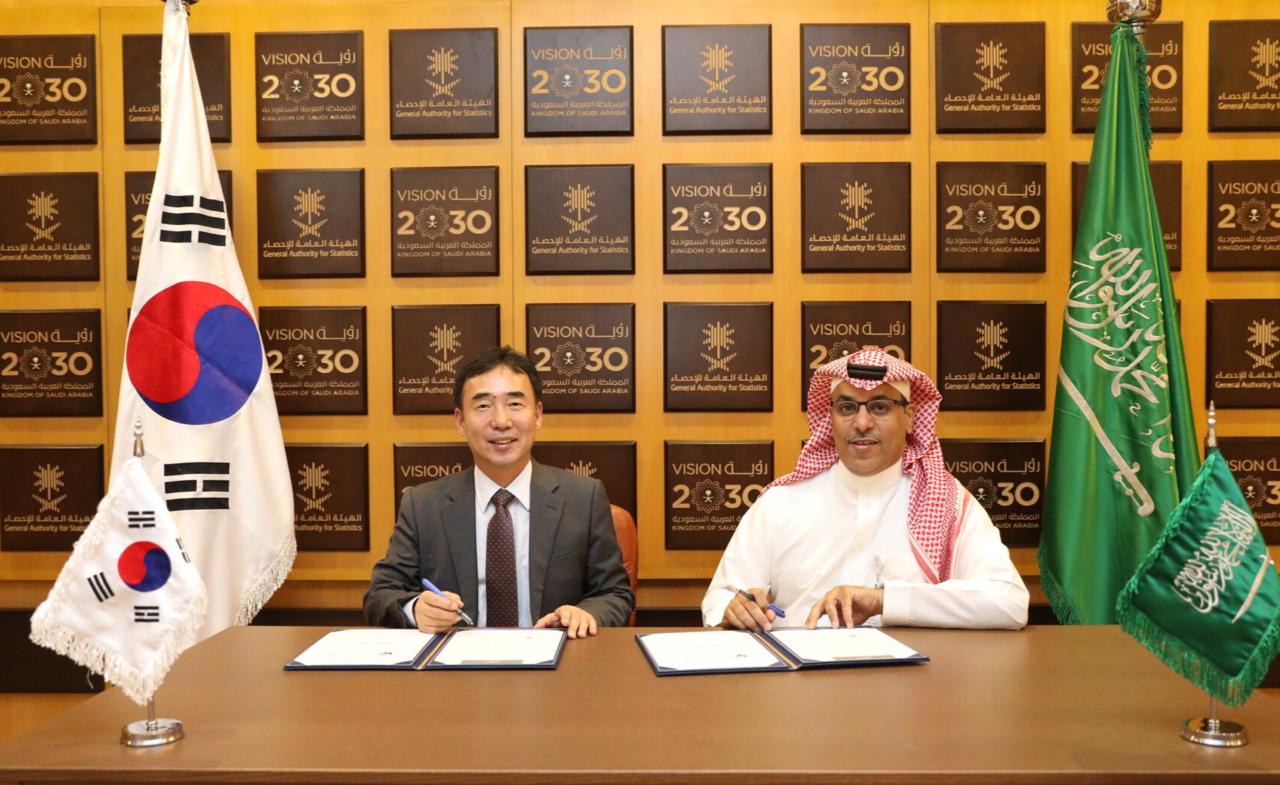
Saudi Arabia and South Korea sign a joint work agreement to develop statistical work in both countries

20-09-2018

in order to transfer international practices and benefit from statistical experiences Saudi Arabia and South Korea sign a joint work agreement to develop statistical work in both countries On Thursday Muharram 3, 1440-H, corresponding to September 13, 2018, in the Saudi capital Riyadh,  the General Authority for Statistics (GASTAT) in  Saudi Arabia and Korea's statistics in the Republic of South Korea signed a joint work agreement related to the development of statistical aspects in order to activate the memorandum of understanding between the two countries for cooperation in the field of statistics that took place in the  Korean capital “Seoul” last year and adopted by the Council of Ministers on 25/08 / 1439H corresponding to 10/5/2018.  Additionally, the agreement was signed by the President of GASTAT Dr. Fahad S. Altekhaifi from the Saudi side , and by the official commissioner deputy of the Korean statistics  , Mr.Sungwook Choi from the Korean side. GASTAT official spokesman, Mr. Taiseer Almofarrej, explained that under these agreements, the Authority will benefit from best international  practices in developing technical mechanisms  necessary to collect and publish statistics according to international standards,  identify statistical databases basics in various fields of statistics and exchange of experiences related to the requirements necessary to establish a central information system that is automatically linked with all public entities. It is noteworthy that this is what GASTAT is currently working on, through the National Statistical Data Program “Masdar” which operates according to three main dimensions: First,  a statistical dimension that addresses the numerous sources of data and statistical indicators and their inconsistencies, their multiple classifications, as well as their collection in a traditional way. Second,  availability and dissemination dimension that addresses the limited access to information in their time series and overcome some of the difficulties faced by data users and researchers to reach them. Third, the technical dimension, as “Masdar” is considered a safe and comprehensive technical solution that addresses the enormity of statistical data and the absence of central data repositories, to serve as a national statistical data bank and provide a variety of analytical tools that meet the needs of all analysts, researchers or decision makers. Almofarrej also added that the agreement  with the South Korean side included defining joint work mechanisms in exchange of experiences and benefiting from experts in the fields of establishing statistical departments in governmental entities as well as in the fields of statistical awareness programs, which will have a positive impact on the Authority, as it is currently working with a number of governmental entities in the Kingdom with a goal to activate the statistical sector. Furthermore, he pointed out that  the Korean experience in the statistical field is considered  one of the most  distinct experiences internationally, and is the Saudi experience which characterized  by  the achievement of "statistical transformation. The South Korean delegation, during their visit to GASTAT, reviewed the work mechanisms  that were carried out by the Authority during the last three years in the program of statistical transformation that was  featured by integration with other governmental  entities to maximize the use of data in supporting of decision-making and policy-making.  Moreover, The Korean delegation reviewed work mechanisms  in raising data quality level that operated by the Authority through an administrative and technical  system in order to reach the highest level of data quality. On the other hand,  the head of  the Korean delegation expressed his deep gratitude to the Saudi side for the hospitality and  generosity after concluding the visit of the Korean delegation, which lasted two days with a number of meetings and workshops. He  also stressed the deep relations between the two countries, which span more than half a century as well as how Saudi and South Korea's relations have  significantly developed in all fields especially in the economic field.
Image Alt Text

Saudi Arabia and South Korea sign a joint work agreement to develop statistical work in both countries

20-09-2018

in order to transfer international practices and benefit from statistical experiences Saudi Arabia and South Korea sign a joint work agreement to develop statistical work in both countries On Thursday Muharram 3, 1440-H, corresponding to September 13, 2018, in the Saudi capital Riyadh,  the General Authority for Statistics (GASTAT) in  Saudi Arabia and Korea's statistics in the Republic of South Korea signed a joint work agreement related to the development of statistical aspects in order to activate the memorandum of understanding between the two countries for cooperation in the field of statistics that took place in the  Korean capital “Seoul” last year and adopted by the Council of Ministers on 25/08 / 1439H corresponding to 10/5/2018.  Additionally, the agreement was signed by the President of GASTAT Dr. Fahad S. Altekhaifi from the Saudi side , and by the official commissioner deputy of the Korean statistics  , Mr.Sungwook Choi from the Korean side. GASTAT official spokesman, Mr. Taiseer Almofarrej, explained that under these agreements, the Authority will benefit from best international  practices in developing technical mechanisms  necessary to collect and publish statistics according to international standards,  identify statistical databases basics in various fields of statistics and exchange of experiences related to the requirements necessary to establish a central information system that is automatically linked with all public entities. It is noteworthy that this is what GASTAT is currently working on, through the National Statistical Data Program “Masdar” which operates according to three main dimensions: First,  a statistical dimension that addresses the numerous sources of data and statistical indicators and their inconsistencies, their multiple classifications, as well as their collection in a traditional way. Second,  availability and dissemination dimension that addresses the limited access to information in their time series and overcome some of the difficulties faced by data users and researchers to reach them. Third, the technical dimension, as “Masdar” is considered a safe and comprehensive technical solution that addresses the enormity of statistical data and the absence of central data repositories, to serve as a national statistical data bank and provide a variety of analytical tools that meet the needs of all analysts, researchers or decision makers. Almofarrej also added that the agreement  with the South Korean side included defining joint work mechanisms in exchange of experiences and benefiting from experts in the fields of establishing statistical departments in governmental entities as well as in the fields of statistical awareness programs, which will have a positive impact on the Authority, as it is currently working with a number of governmental entities in the Kingdom with a goal to activate the statistical sector. Furthermore, he pointed out that  the Korean experience in the statistical field is considered  one of the most  distinct experiences internationally, and is the Saudi experience which characterized  by  the achievement of "statistical transformation. The South Korean delegation, during their visit to GASTAT, reviewed the work mechanisms  that were carried out by the Authority during the last three years in the program of statistical transformation that was  featured by integration with other governmental  entities to maximize the use of data in supporting of decision-making and policy-making.  Moreover, The Korean delegation reviewed work mechanisms  in raising data quality level that operated by the Authority through an administrative and technical  system in order to reach the highest level of data quality. On the other hand,  the head of  the Korean delegation expressed his deep gratitude to the Saudi side for the hospitality and  generosity after concluding the visit of the Korean delegation, which lasted two days with a number of meetings and workshops. He  also stressed the deep relations between the two countries, which span more than half a century as well as how Saudi and South Korea's relations have  significantly developed in all fields especially in the economic field.
Image Alt Text

The President of GaStat Congratulates the Leadership on the Success of the Hajj Season for This Year

29-08-2018

Expressing His Gratitude to All Private and Governmental Entities Which Contributed in Showing the Efforts of the Kingdom in Serving the Pilgrims The President of GaStat Congratulates the Leadership on the Success of the Hajj Season for This Year On behalf of GaStat employees and on his own behalf, Dr.Fahad Bin Sulaiman AL-Tukhaifi congratulates The Custodian of the Two Holy Mosques King Salman Bin Abdulaziz AL-Saud,  and HRH Prince Mohammed Bin Salman Al-Saud Deputy Crown Prince, Second Deputy Prime Minister and Minister of Defense of Saudi Arabia, May Allah protect them, on the success of the hajj season for the current year 1439 H. Assuring that the directions of the King and the Crown Prince to provide all amenities for the pilgrims were the fundamental for the GaStat and all private and governmental entities to implement their programs to serve the pilgrims. Moreover, he has indicated that the concern of the leadership, May Allah protect them, was the reason behind the all successes  that have been achieved during the hajj season of this year, where all sectors have worked closely to achieve the expectations of the leadership in reality.   Moreover, the president of GaStat,  has extended his congratulations to HRH Prince Khalid ALFaisal Bin Abdulaziz , the Advisor to the Custodian of the Two Holy Mosques, Governor of Makkah Province and the Chairman of the Central Hajj Committee, for his effective role in following-up the implementations of the Hajj’s plans up to date and for his concern to ensure comfort for pilgrims by providing all the means that could help them to perform the rituals easily. In addition, Dr. AL-Tukhaifi congratulates HRH Prince Abdulaziz Bin Saud Bin Naif Bin Abdulaziz, the Minister of Interior and the Chairman of the High Hajj Committee, on the success of  the 1439 hajj season as well as his own implementation plans, with Allah’s help.  Moreover, He has praised the great role that has been played by the employees of the Ministry of Interior from all security sectors for the success of the hajj for this year. As usual, they were distinguished with their dedication in showing the honor of serving the pilgrims. Dr.AL-Tukhifi also wishes all the best and success for them and for everyone. Additionally, the president of GaStat has announced the success of the hajj statistical plan for this year, with Allah’s help, and with the early preparation and teamwork spirit of GaStat employees , where they have worked closely with all governmental and security entities to implement the hajj statistical program. They were also able to provide a comprehensive and accurate statistical outputs to support all decision makers and hajj development policies makers through the detailed statistical bulletin for hajj statistics, which includes 40 statistical outputs. Also, by publishing the statistics of the efforts of Saudi Arabia in serving pilgrims through “the statistical calendar for 1439H hajj season” which has been published for the second year respectively through GaStat. The president of GaStat has expressed his gratitude to all governmental entities which provided their data to GaStat, in advance, to be used to show the efforts of the Kingdom by numbers and a scientific and accurate statistical method. It is worth mentioning that the GASTAT has  announced on the evening of the day of 'Arafa the results of hajj statistics for the current  year 1439H, where the total number of pilgrims reached (2.371.675) pilgrims, including (1,758.722) pilgrims coming from outside the Kingdom, while the number of pilgrims coming from inside the Kingdom made up of (612.953) pilgrims.
Image Alt Text

The President of GaStat Congratulates the Leadership on the Success of the Hajj Season for This Year

29-08-2018

Expressing His Gratitude to All Private and Governmental Entities Which Contributed in Showing the Efforts of the Kingdom in Serving the Pilgrims The President of GaStat Congratulates the Leadership on the Success of the Hajj Season for This Year On behalf of GaStat employees and on his own behalf, Dr.Fahad Bin Sulaiman AL-Tukhaifi congratulates The Custodian of the Two Holy Mosques King Salman Bin Abdulaziz AL-Saud,  and HRH Prince Mohammed Bin Salman Al-Saud Deputy Crown Prince, Second Deputy Prime Minister and Minister of Defense of Saudi Arabia, May Allah protect them, on the success of the hajj season for the current year 1439 H. Assuring that the directions of the King and the Crown Prince to provide all amenities for the pilgrims were the fundamental for the GaStat and all private and governmental entities to implement their programs to serve the pilgrims. Moreover, he has indicated that the concern of the leadership, May Allah protect them, was the reason behind the all successes  that have been achieved during the hajj season of this year, where all sectors have worked closely to achieve the expectations of the leadership in reality.   Moreover, the president of GaStat,  has extended his congratulations to HRH Prince Khalid ALFaisal Bin Abdulaziz , the Advisor to the Custodian of the Two Holy Mosques, Governor of Makkah Province and the Chairman of the Central Hajj Committee, for his effective role in following-up the implementations of the Hajj’s plans up to date and for his concern to ensure comfort for pilgrims by providing all the means that could help them to perform the rituals easily. In addition, Dr. AL-Tukhaifi congratulates HRH Prince Abdulaziz Bin Saud Bin Naif Bin Abdulaziz, the Minister of Interior and the Chairman of the High Hajj Committee, on the success of  the 1439 hajj season as well as his own implementation plans, with Allah’s help.  Moreover, He has praised the great role that has been played by the employees of the Ministry of Interior from all security sectors for the success of the hajj for this year. As usual, they were distinguished with their dedication in showing the honor of serving the pilgrims. Dr.AL-Tukhifi also wishes all the best and success for them and for everyone. Additionally, the president of GaStat has announced the success of the hajj statistical plan for this year, with Allah’s help, and with the early preparation and teamwork spirit of GaStat employees , where they have worked closely with all governmental and security entities to implement the hajj statistical program. They were also able to provide a comprehensive and accurate statistical outputs to support all decision makers and hajj development policies makers through the detailed statistical bulletin for hajj statistics, which includes 40 statistical outputs. Also, by publishing the statistics of the efforts of Saudi Arabia in serving pilgrims through “the statistical calendar for 1439H hajj season” which has been published for the second year respectively through GaStat. The president of GaStat has expressed his gratitude to all governmental entities which provided their data to GaStat, in advance, to be used to show the efforts of the Kingdom by numbers and a scientific and accurate statistical method. It is worth mentioning that the GASTAT has  announced on the evening of the day of 'Arafa the results of hajj statistics for the current  year 1439H, where the total number of pilgrims reached (2.371.675) pilgrims, including (1,758.722) pilgrims coming from outside the Kingdom, while the number of pilgrims coming from inside the Kingdom made up of (612.953) pilgrims.
Image Alt Text

GASTAT launches the “Hajj statistical map” to publish data and facilitate information access

27-08-2018

To know the statistics details of pilgrims arriving to Makkah every (6) hours GASTAT launches the “Hajj statistical map” to publish data and facilitate information access The General Authority for Statistics (GASTAT) launched the “ Hajj statistical map” on its official website www.stats.gov.sa . This map is considered one of the most important references that clarifies the details of pilgrims’ statistics data, and facilitates information access to media, researchers, and governmental entities, so that they can use them in details and with the most advanced methods of “geo-spatial” data publishing. The map can be viewed via different multimedia.   Taiseer Almofarrej, GASTAT spokesman, said that the process of letting people view Hajj statistics data complements GASTAT efforts in publishing statistical data. Everyone can view the numbers of pilgrims arriving to Makkah through all ports in an updated way (every six hours), starting from Saturday the 7th of Dhu-Al-Hijjah until the end of pilgrims’ enumeration on Monday the 9th of Dhu-Al-Hijjah at 7 P.M. This map will be an interactive statistical reference for Hajj statistics.  Almofarrej indicated that the Hajj statistical map has two tracks; the first is the news track through which hajj statistics can be accessed in an updated way (every six hours) via the map. The numbers of pilgrims coming from outside Saudi Arabia, and the numbers of pilgrims coming from inside Saudi Arabia (Saudis and Non-Saudis) can be accessed too. Moreover, this track includes the number of vehicles carrying pilgrims from inside Saudi Arabia by type of vehicle, the number of licenses given to pilgrims from inside Saudi Arabia, and the traffic map in the holy places area.  However, the second track, as stated by GASTAT spokesman, is a statistical reference track. Starting from Tuesday, the tenth of Dhu-Al-Hijjah, the interactive map will be one of the Hajj statistics’ detailed bulletin templates through which all governmental entities, researchers, media, and all those who are interested can get the numbers of pilgrims from inside and outside Saudi Arabia, the statistical distributions of pilgrims from inside Saudi Arabia at the level of enumeration centers, number of Saudi and Non-Saudi pilgrims from inside Saudi Arabia, number of Non-Saudi pilgrims from inside and outside Saudi Arabia by groups of countries, estimating the numbers of pilgrims in Makkah, number of labor forces serving pilgrims by gender and sector, and the numbers and types of vehicles carrying pilgrims from inside Saudi Arabia during the period (from 1st  to 9th  of Dhu-Al-Hijjah). The interactive map will provide details of gender and nationality by entry, in addition to the time series of pilgrims during the past ten years.   It is worth mentioning that GASTAT is working on diversifying the methods of getting data in a detailed and immediate way through all available means. It has also launched the “statistical calendar of 1439 H Hajj season” in which it published the services provided by Saudi Arabia to pilgrims.
Image Alt Text

GASTAT launches the “Hajj statistical map” to publish data and facilitate information access

27-08-2018

To know the statistics details of pilgrims arriving to Makkah every (6) hours GASTAT launches the “Hajj statistical map” to publish data and facilitate information access The General Authority for Statistics (GASTAT) launched the “ Hajj statistical map” on its official website www.stats.gov.sa . This map is considered one of the most important references that clarifies the details of pilgrims’ statistics data, and facilitates information access to media, researchers, and governmental entities, so that they can use them in details and with the most advanced methods of “geo-spatial” data publishing. The map can be viewed via different multimedia.   Taiseer Almofarrej, GASTAT spokesman, said that the process of letting people view Hajj statistics data complements GASTAT efforts in publishing statistical data. Everyone can view the numbers of pilgrims arriving to Makkah through all ports in an updated way (every six hours), starting from Saturday the 7th of Dhu-Al-Hijjah until the end of pilgrims’ enumeration on Monday the 9th of Dhu-Al-Hijjah at 7 P.M. This map will be an interactive statistical reference for Hajj statistics.  Almofarrej indicated that the Hajj statistical map has two tracks; the first is the news track through which hajj statistics can be accessed in an updated way (every six hours) via the map. The numbers of pilgrims coming from outside Saudi Arabia, and the numbers of pilgrims coming from inside Saudi Arabia (Saudis and Non-Saudis) can be accessed too. Moreover, this track includes the number of vehicles carrying pilgrims from inside Saudi Arabia by type of vehicle, the number of licenses given to pilgrims from inside Saudi Arabia, and the traffic map in the holy places area.  However, the second track, as stated by GASTAT spokesman, is a statistical reference track. Starting from Tuesday, the tenth of Dhu-Al-Hijjah, the interactive map will be one of the Hajj statistics’ detailed bulletin templates through which all governmental entities, researchers, media, and all those who are interested can get the numbers of pilgrims from inside and outside Saudi Arabia, the statistical distributions of pilgrims from inside Saudi Arabia at the level of enumeration centers, number of Saudi and Non-Saudi pilgrims from inside Saudi Arabia, number of Non-Saudi pilgrims from inside and outside Saudi Arabia by groups of countries, estimating the numbers of pilgrims in Makkah, number of labor forces serving pilgrims by gender and sector, and the numbers and types of vehicles carrying pilgrims from inside Saudi Arabia during the period (from 1st  to 9th  of Dhu-Al-Hijjah). The interactive map will provide details of gender and nationality by entry, in addition to the time series of pilgrims during the past ten years.   It is worth mentioning that GASTAT is working on diversifying the methods of getting data in a detailed and immediate way through all available means. It has also launched the “statistical calendar of 1439 H Hajj season” in which it published the services provided by Saudi Arabia to pilgrims.
Image Alt Text

GaStat operates an advanced technical system in the implementation of "Hajj statistics"

27-08-2018

Hajj statistics updates every (6 hours) via an interactive map on the site GaStat operates an advanced technical system in the implementation of "Hajj statistics" The General Authority for Statistics (GaStat) is currently implementing a comprehensive technical system, with more than 470 statistical researchers working in six main entrances to Makkah and three support centers in Medinah, Jeddah and Al Tai’f. The system is connected to a secure electronic network for simultaneous and immediate data flow to the main centers.  Moreover, the GaStat updates the interactive statistical map of  Hajj  every six hours through its official website www.stats.gov.sa   Mr. Khalid Al-Dalqan, Information Technology Under Secretary at GaStat, said that GaStat is working continuously to develop the methodologies and programs needed to collect, process, analyze and disseminate data to achieve comprehensiveness, reliability and timeliness in data dissemination through the use of modern technology that contributes to reducing the time and place factors which may delay data processing speed and accuracy as well as the speed of extraction and data dissemination during Hajj.  GaStat has applied a modern method of collecting field data using the latest technology and software by using electronic forms on tablets when counting pilgrims, which allow quick access to daily data and total results of the number of pilgrims classified according to their nationalities, centers and times of arrival. He added that all statistical researchers in Mekkah have been trained to use modern technology and devices effectively to implement the Hajj statistics program using tablets connected with the main servers in Riyadh in addition to the link to backup servers in all statistical centers that work offline if needed.  Moreover, Al-Dalqan said that the Authority has allocated a technical support team working around the clock ( in order to train all employees categories to use Hajj systems, know  how to extract daily reports, follow up the productivity of field work groups and solve all technical problems that may face the work groups during data collection), Furthermore, it has dedicated other work teams for the preparation  distributed to all main and support statistical centers. GaStat provided analysis and design teams as well as a team to develop data collection systems, including the tablet  system used to collect field data that includes a digital form to count pilgrims containing all data on the results of pilgrims enumeration numbers arriving in Makkah connected to the coordinates of the information gathering site. These devices work via a remote control systems that allow the tracking devices to provide remote technical support.    On the other hand, Information Technology Under Secretary at the GaStat pointed out that the Hajj statistics platform of the technical system was added to Hajj  of this year for the main center and the main counting centers. This allows the specialists to review the pilgrims statistics of this year updated in comparison to the historical data at the level of arrival centers of pilgrims coming from inside the Kingdom,  their nationalities, arrival time and types of vehicles, in addition to the statistics of pilgrims coming from outside the Kingdom as well as the pilgrims of Mekkah. It is worth mentioning that GaStat has standardized the definitions and terminology used in Hajj statistics, where the pilgrim is the counting unit. The process of counting pilgrims coming from inside the Kingdom is limited to the persons wearing Ihram who are already been counted at the centers of Hajj statistics at the entrances to Makkah. The counting includes All Saudi and non-Saudi individuals, males and females, coming from different regions of the Kingdom to Makkah for the purpose of performing Hajj, with the addition of the total number of pilgrims coming from outside the Kingdom counted by the General Directorate of Passports at the points of entry in the Kingdom of Saudi Arabia.
Image Alt Text

GaStat operates an advanced technical system in the implementation of "Hajj statistics"

27-08-2018

Hajj statistics updates every (6 hours) via an interactive map on the site GaStat operates an advanced technical system in the implementation of "Hajj statistics" The General Authority for Statistics (GaStat) is currently implementing a comprehensive technical system, with more than 470 statistical researchers working in six main entrances to Makkah and three support centers in Medinah, Jeddah and Al Tai’f. The system is connected to a secure electronic network for simultaneous and immediate data flow to the main centers.  Moreover, the GaStat updates the interactive statistical map of  Hajj  every six hours through its official website www.stats.gov.sa   Mr. Khalid Al-Dalqan, Information Technology Under Secretary at GaStat, said that GaStat is working continuously to develop the methodologies and programs needed to collect, process, analyze and disseminate data to achieve comprehensiveness, reliability and timeliness in data dissemination through the use of modern technology that contributes to reducing the time and place factors which may delay data processing speed and accuracy as well as the speed of extraction and data dissemination during Hajj.  GaStat has applied a modern method of collecting field data using the latest technology and software by using electronic forms on tablets when counting pilgrims, which allow quick access to daily data and total results of the number of pilgrims classified according to their nationalities, centers and times of arrival. He added that all statistical researchers in Mekkah have been trained to use modern technology and devices effectively to implement the Hajj statistics program using tablets connected with the main servers in Riyadh in addition to the link to backup servers in all statistical centers that work offline if needed.  Moreover, Al-Dalqan said that the Authority has allocated a technical support team working around the clock ( in order to train all employees categories to use Hajj systems, know  how to extract daily reports, follow up the productivity of field work groups and solve all technical problems that may face the work groups during data collection), Furthermore, it has dedicated other work teams for the preparation  distributed to all main and support statistical centers. GaStat provided analysis and design teams as well as a team to develop data collection systems, including the tablet  system used to collect field data that includes a digital form to count pilgrims containing all data on the results of pilgrims enumeration numbers arriving in Makkah connected to the coordinates of the information gathering site. These devices work via a remote control systems that allow the tracking devices to provide remote technical support.    On the other hand, Information Technology Under Secretary at the GaStat pointed out that the Hajj statistics platform of the technical system was added to Hajj  of this year for the main center and the main counting centers. This allows the specialists to review the pilgrims statistics of this year updated in comparison to the historical data at the level of arrival centers of pilgrims coming from inside the Kingdom,  their nationalities, arrival time and types of vehicles, in addition to the statistics of pilgrims coming from outside the Kingdom as well as the pilgrims of Mekkah. It is worth mentioning that GaStat has standardized the definitions and terminology used in Hajj statistics, where the pilgrim is the counting unit. The process of counting pilgrims coming from inside the Kingdom is limited to the persons wearing Ihram who are already been counted at the centers of Hajj statistics at the entrances to Makkah. The counting includes All Saudi and non-Saudi individuals, males and females, coming from different regions of the Kingdom to Makkah for the purpose of performing Hajj, with the addition of the total number of pilgrims coming from outside the Kingdom counted by the General Directorate of Passports at the points of entry in the Kingdom of Saudi Arabia.
Image Alt Text

Saudi Arabia and South Korea sign a joint work agreement to develop statistical work in both countries

20-09-2018

in order to transfer international practices and benefit from statistical experiences Saudi Arabia and South Korea sign a joint work agreement to develop statistical work in both countries On Thursday Muharram 3, 1440-H, corresponding to September 13, 2018, in the Saudi capital Riyadh,  the General Authority for Statistics (GASTAT) in  Saudi Arabia and Korea's statistics in the Republic of South Korea signed a joint work agreement related to the development of statistical aspects in order to activate the memorandum of understanding between the two countries for cooperation in the field of statistics that took place in the  Korean capital “Seoul” last year and adopted by the Council of Ministers on 25/08 / 1439H corresponding to 10/5/2018.  Additionally, the agreement was signed by the President of GASTAT Dr. Fahad S. Altekhaifi from the Saudi side , and by the official commissioner deputy of the Korean statistics  , Mr.Sungwook Choi from the Korean side. GASTAT official spokesman, Mr. Taiseer Almofarrej, explained that under these agreements, the Authority will benefit from best international  practices in developing technical mechanisms  necessary to collect and publish statistics according to international standards,  identify statistical databases basics in various fields of statistics and exchange of experiences related to the requirements necessary to establish a central information system that is automatically linked with all public entities. It is noteworthy that this is what GASTAT is currently working on, through the National Statistical Data Program “Masdar” which operates according to three main dimensions: First,  a statistical dimension that addresses the numerous sources of data and statistical indicators and their inconsistencies, their multiple classifications, as well as their collection in a traditional way. Second,  availability and dissemination dimension that addresses the limited access to information in their time series and overcome some of the difficulties faced by data users and researchers to reach them. Third, the technical dimension, as “Masdar” is considered a safe and comprehensive technical solution that addresses the enormity of statistical data and the absence of central data repositories, to serve as a national statistical data bank and provide a variety of analytical tools that meet the needs of all analysts, researchers or decision makers. Almofarrej also added that the agreement  with the South Korean side included defining joint work mechanisms in exchange of experiences and benefiting from experts in the fields of establishing statistical departments in governmental entities as well as in the fields of statistical awareness programs, which will have a positive impact on the Authority, as it is currently working with a number of governmental entities in the Kingdom with a goal to activate the statistical sector. Furthermore, he pointed out that  the Korean experience in the statistical field is considered  one of the most  distinct experiences internationally, and is the Saudi experience which characterized  by  the achievement of "statistical transformation. The South Korean delegation, during their visit to GASTAT, reviewed the work mechanisms  that were carried out by the Authority during the last three years in the program of statistical transformation that was  featured by integration with other governmental  entities to maximize the use of data in supporting of decision-making and policy-making.  Moreover, The Korean delegation reviewed work mechanisms  in raising data quality level that operated by the Authority through an administrative and technical  system in order to reach the highest level of data quality. On the other hand,  the head of  the Korean delegation expressed his deep gratitude to the Saudi side for the hospitality and  generosity after concluding the visit of the Korean delegation, which lasted two days with a number of meetings and workshops. He  also stressed the deep relations between the two countries, which span more than half a century as well as how Saudi and South Korea's relations have  significantly developed in all fields especially in the economic field.
Image Alt Text

The President of GaStat Congratulates the Leadership on the Success of the Hajj Season for This Year

29-08-2018

Expressing His Gratitude to All Private and Governmental Entities Which Contributed in Showing the Efforts of the Kingdom in Serving the Pilgrims The President of GaStat Congratulates the Leadership on the Success of the Hajj Season for This Year On behalf of GaStat employees and on his own behalf, Dr.Fahad Bin Sulaiman AL-Tukhaifi congratulates The Custodian of the Two Holy Mosques King Salman Bin Abdulaziz AL-Saud,  and HRH Prince Mohammed Bin Salman Al-Saud Deputy Crown Prince, Second Deputy Prime Minister and Minister of Defense of Saudi Arabia, May Allah protect them, on the success of the hajj season for the current year 1439 H. Assuring that the directions of the King and the Crown Prince to provide all amenities for the pilgrims were the fundamental for the GaStat and all private and governmental entities to implement their programs to serve the pilgrims. Moreover, he has indicated that the concern of the leadership, May Allah protect them, was the reason behind the all successes  that have been achieved during the hajj season of this year, where all sectors have worked closely to achieve the expectations of the leadership in reality.   Moreover, the president of GaStat,  has extended his congratulations to HRH Prince Khalid ALFaisal Bin Abdulaziz , the Advisor to the Custodian of the Two Holy Mosques, Governor of Makkah Province and the Chairman of the Central Hajj Committee, for his effective role in following-up the implementations of the Hajj’s plans up to date and for his concern to ensure comfort for pilgrims by providing all the means that could help them to perform the rituals easily. In addition, Dr. AL-Tukhaifi congratulates HRH Prince Abdulaziz Bin Saud Bin Naif Bin Abdulaziz, the Minister of Interior and the Chairman of the High Hajj Committee, on the success of  the 1439 hajj season as well as his own implementation plans, with Allah’s help.  Moreover, He has praised the great role that has been played by the employees of the Ministry of Interior from all security sectors for the success of the hajj for this year. As usual, they were distinguished with their dedication in showing the honor of serving the pilgrims. Dr.AL-Tukhifi also wishes all the best and success for them and for everyone. Additionally, the president of GaStat has announced the success of the hajj statistical plan for this year, with Allah’s help, and with the early preparation and teamwork spirit of GaStat employees , where they have worked closely with all governmental and security entities to implement the hajj statistical program. They were also able to provide a comprehensive and accurate statistical outputs to support all decision makers and hajj development policies makers through the detailed statistical bulletin for hajj statistics, which includes 40 statistical outputs. Also, by publishing the statistics of the efforts of Saudi Arabia in serving pilgrims through “the statistical calendar for 1439H hajj season” which has been published for the second year respectively through GaStat. The president of GaStat has expressed his gratitude to all governmental entities which provided their data to GaStat, in advance, to be used to show the efforts of the Kingdom by numbers and a scientific and accurate statistical method. It is worth mentioning that the GASTAT has  announced on the evening of the day of 'Arafa the results of hajj statistics for the current  year 1439H, where the total number of pilgrims reached (2.371.675) pilgrims, including (1,758.722) pilgrims coming from outside the Kingdom, while the number of pilgrims coming from inside the Kingdom made up of (612.953) pilgrims.
Image Alt Text

GASTAT launches the “Hajj statistical map” to publish data and facilitate information access

27-08-2018

To know the statistics details of pilgrims arriving to Makkah every (6) hours GASTAT launches the “Hajj statistical map” to publish data and facilitate information access The General Authority for Statistics (GASTAT) launched the “ Hajj statistical map” on its official website www.stats.gov.sa . This map is considered one of the most important references that clarifies the details of pilgrims’ statistics data, and facilitates information access to media, researchers, and governmental entities, so that they can use them in details and with the most advanced methods of “geo-spatial” data publishing. The map can be viewed via different multimedia.   Taiseer Almofarrej, GASTAT spokesman, said that the process of letting people view Hajj statistics data complements GASTAT efforts in publishing statistical data. Everyone can view the numbers of pilgrims arriving to Makkah through all ports in an updated way (every six hours), starting from Saturday the 7th of Dhu-Al-Hijjah until the end of pilgrims’ enumeration on Monday the 9th of Dhu-Al-Hijjah at 7 P.M. This map will be an interactive statistical reference for Hajj statistics.  Almofarrej indicated that the Hajj statistical map has two tracks; the first is the news track through which hajj statistics can be accessed in an updated way (every six hours) via the map. The numbers of pilgrims coming from outside Saudi Arabia, and the numbers of pilgrims coming from inside Saudi Arabia (Saudis and Non-Saudis) can be accessed too. Moreover, this track includes the number of vehicles carrying pilgrims from inside Saudi Arabia by type of vehicle, the number of licenses given to pilgrims from inside Saudi Arabia, and the traffic map in the holy places area.  However, the second track, as stated by GASTAT spokesman, is a statistical reference track. Starting from Tuesday, the tenth of Dhu-Al-Hijjah, the interactive map will be one of the Hajj statistics’ detailed bulletin templates through which all governmental entities, researchers, media, and all those who are interested can get the numbers of pilgrims from inside and outside Saudi Arabia, the statistical distributions of pilgrims from inside Saudi Arabia at the level of enumeration centers, number of Saudi and Non-Saudi pilgrims from inside Saudi Arabia, number of Non-Saudi pilgrims from inside and outside Saudi Arabia by groups of countries, estimating the numbers of pilgrims in Makkah, number of labor forces serving pilgrims by gender and sector, and the numbers and types of vehicles carrying pilgrims from inside Saudi Arabia during the period (from 1st  to 9th  of Dhu-Al-Hijjah). The interactive map will provide details of gender and nationality by entry, in addition to the time series of pilgrims during the past ten years.   It is worth mentioning that GASTAT is working on diversifying the methods of getting data in a detailed and immediate way through all available means. It has also launched the “statistical calendar of 1439 H Hajj season” in which it published the services provided by Saudi Arabia to pilgrims.
Image Alt Text

GaStat operates an advanced technical system in the implementation of "Hajj statistics"

27-08-2018

Hajj statistics updates every (6 hours) via an interactive map on the site GaStat operates an advanced technical system in the implementation of "Hajj statistics" The General Authority for Statistics (GaStat) is currently implementing a comprehensive technical system, with more than 470 statistical researchers working in six main entrances to Makkah and three support centers in Medinah, Jeddah and Al Tai’f. The system is connected to a secure electronic network for simultaneous and immediate data flow to the main centers.  Moreover, the GaStat updates the interactive statistical map of  Hajj  every six hours through its official website www.stats.gov.sa   Mr. Khalid Al-Dalqan, Information Technology Under Secretary at GaStat, said that GaStat is working continuously to develop the methodologies and programs needed to collect, process, analyze and disseminate data to achieve comprehensiveness, reliability and timeliness in data dissemination through the use of modern technology that contributes to reducing the time and place factors which may delay data processing speed and accuracy as well as the speed of extraction and data dissemination during Hajj.  GaStat has applied a modern method of collecting field data using the latest technology and software by using electronic forms on tablets when counting pilgrims, which allow quick access to daily data and total results of the number of pilgrims classified according to their nationalities, centers and times of arrival. He added that all statistical researchers in Mekkah have been trained to use modern technology and devices effectively to implement the Hajj statistics program using tablets connected with the main servers in Riyadh in addition to the link to backup servers in all statistical centers that work offline if needed.  Moreover, Al-Dalqan said that the Authority has allocated a technical support team working around the clock ( in order to train all employees categories to use Hajj systems, know  how to extract daily reports, follow up the productivity of field work groups and solve all technical problems that may face the work groups during data collection), Furthermore, it has dedicated other work teams for the preparation  distributed to all main and support statistical centers. GaStat provided analysis and design teams as well as a team to develop data collection systems, including the tablet  system used to collect field data that includes a digital form to count pilgrims containing all data on the results of pilgrims enumeration numbers arriving in Makkah connected to the coordinates of the information gathering site. These devices work via a remote control systems that allow the tracking devices to provide remote technical support.    On the other hand, Information Technology Under Secretary at the GaStat pointed out that the Hajj statistics platform of the technical system was added to Hajj  of this year for the main center and the main counting centers. This allows the specialists to review the pilgrims statistics of this year updated in comparison to the historical data at the level of arrival centers of pilgrims coming from inside the Kingdom,  their nationalities, arrival time and types of vehicles, in addition to the statistics of pilgrims coming from outside the Kingdom as well as the pilgrims of Mekkah. It is worth mentioning that GaStat has standardized the definitions and terminology used in Hajj statistics, where the pilgrim is the counting unit. The process of counting pilgrims coming from inside the Kingdom is limited to the persons wearing Ihram who are already been counted at the centers of Hajj statistics at the entrances to Makkah. The counting includes All Saudi and non-Saudi individuals, males and females, coming from different regions of the Kingdom to Makkah for the purpose of performing Hajj, with the addition of the total number of pilgrims coming from outside the Kingdom counted by the General Directorate of Passports at the points of entry in the Kingdom of Saudi Arabia.
Sort